


“It’s true that there is in you a kind of air of communist youth, summer camp, ‘onward comrades!’ and all that. It’s leftist kitsch. But this is only one of your aspects, because, on the other hand, what moves you in all of this is a kind of passion for the currents of active energy that blow gusts of air into the social body, which then starts to pulsate, in an alternation between the destabilization of the reigning cartographies and the mobilization of a blast of collective intelligence which invents new forms of life. Every time it happens, you become chidlike. Godard said that men don’t have much childhood and are very childish. Well, if what mobilizes your childhood can be called a “people,” making you radiant, running in all directions, in this case the “people” isn’t a thing – it isn’t a class, or group, or nation. “People” is the name of these currents, which are not to be confused with the places that they agitate, with the historical contexts that they help to create…
It’s toward these currents that you have spent your life travelling. It has more to do with comets, as Teca said, with a “becoming-comet,” than with a “becoming-scout” or a “becoming-priest.” Perhaps the boy scout and the priest appear because they are the only way, or the age-old way, that we have for dealing with this kind of thing, which lacks a language of its own. That’s why they’re so kitsch. But, behind or through this priest and/or scout, what most draws the attention in the quality of your presence is precisely the opposite of these figures: your insistence on the importance of being attentive to the creation of a different logic, new languages – “minor languages” as you and Gilles call them – your desire to participate actively in this creation.”
(from Molecular Revolution in Brazil)
I really like this quote. It’s Brazilian psychoanalyst Suely Rolnik complimenting Felix Guattari, after a 1982 trip they made through Brazil where they met and discussed with different activist groups and in particular with members of the PT (Partido dos Trabalhadores – Workers Party) including with a young Lula, now the Brazilian president. I like the image of active forces gusting through different bodies and animating them. I also like this concept of becoming-comet, as a subjectivity that starts blazing when it comes into contact with active forces, but has to take its place alongside the child-like enthusiasm of the becoming-scout and the holder of received wisdom of the becoming-priest. As Rolnik says you need: “the coexistence of all these characters and many more still.”
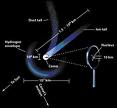
What would a diagram of a becoming-comet look like? Well it can’t be seen when it’s moving through the stillness of the outer solar system but when it comes within the influence of solar heat and wind it bursts into visibility. In fact it makes those active forces visible. We can only see such forces in their effects on bodies and at certain times, particular bodies have affects that illuminate particular forces. Guattari might have been one and Johnny Rotten at a very particular point in time and space might well have been another comet, one that gave off such a bright detritus that you can still just about make it out. But the important point is we mustn’t mistake the body for the force. Those forces move on or change direction and effect; the body in turn might stop being receptive or be unable to find the right affect or combinations to detect those forces. Then all you are left with is the burnt-out husk, a mere cinder of what was. Such is the present-day John Lydon – trapped in a caricature of his younger self, not the vital embodiment of the emergent common that he once was.
Comets have historically been seen as the harbingers of doom but perhaps that’s just a way to talk of them as the harbingers of change. They accompany momentous events. Of course we think we know about comets now, that we can predict their arrival but there are plenty of comets out there with such large orbits that from our historical perspective they are for all intents and purposes unpredictable in both their arrival and their course.

2 Comments